Articles
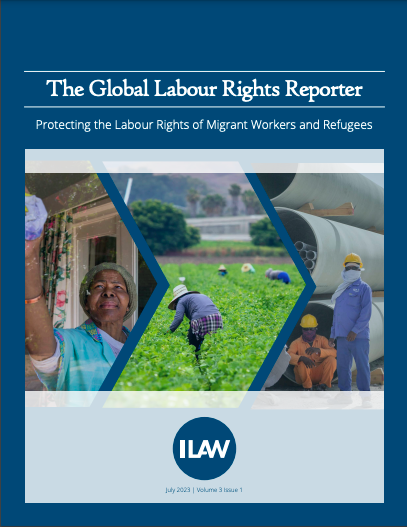
ILAW—THE GLOBAL LABOR RIGHTS REPORTER
Remediation Under US Section 307 of the Tariff Act of 1930: Opportunities for Forced Labour Remediation for Migrant Workers
July 2023
In this article, we discuss a U.S. trade law, Section 307 of the Tariff Act of 1930 (Section 307), under which goods produced with forced or prison labour are prohibited from entering the United States. We suggest that civil society and unions can leverage this law more effectively to benefit migrant workers, who are disproportionately impacted by forced labour, by preparing early for Section 307 remediation and working with companies when they face Section 307 enforcement action to develop and implement remediation plans based on proven methods to root out forced labour for the long run.

December 2022
This article highlights selected opportunities and challenges in the evolving landscape for corporate accountability for human rights abuse in transnational supply chains. It focuses on legislation and litigation in Global North countries, paying particular attention to the emergence of due-diligence legislation across Europe and diverging trends in civil litigation. It was written for the Yale Law Journal’s Volume 132 Forum Collection, “Lock Them™ Up: Holding Transnational Corporate Human-Rights Abusers Accountable.”

February 2021
This short paper presents model clauses that companies can include in supply chain contracts to give those affected access to remedy: supplier and buyer codes of conduct that are enforceable by workers.

April 2019
This article, authored by CAL staff, board, and advisors, and first published in the Harvard Human Rights Journal, is an interdisciplinary examination of the legal, economic, historical and psychological impacts of the human rights situation affecting the Ogoni people of the Niger Delta. The Ogoni have traveled the world seeking justice for the allegedly tortious business practices of Royal Dutch Shell (“Shell”) and its subsidiaries, and the resulting decimation of the Ogoni territory. The article studies the experience of the Ogoni people in their struggle to hold Shell accountable for decades of environmental and human rights abuse, ultimately highlighting the crisis of corporate impunity that victims face across the globe.
Amicus Briefs & Petitions
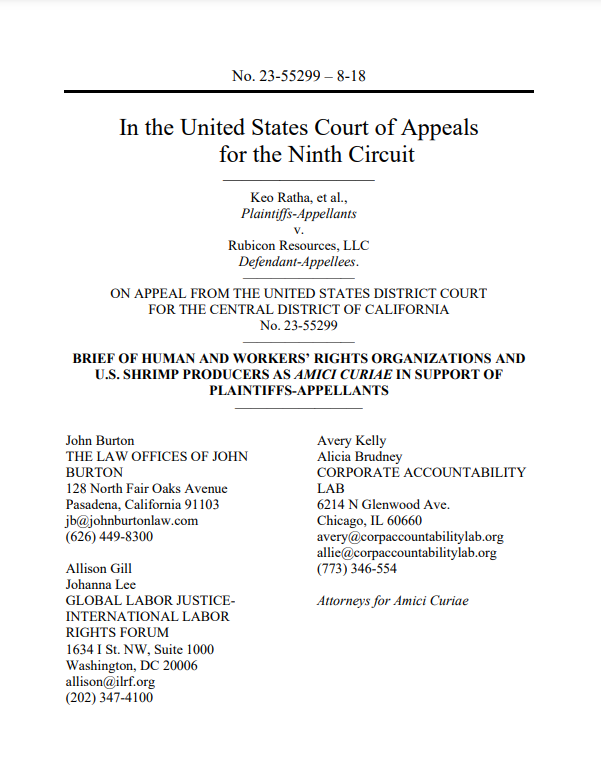
August 2023
CAL, Global Labor Justice-International Labor Rights Forum, and the Law Offices of John Burton filed an amicus brief supporting the plaintiffs in Ratha v. Rubicon, a case brought by Cambodian victim-survivors of human trafficking and forced labor under the Trafficking Victims Protection Reauthorization Act (TVPRA). CAL and our partners filed this brief on behalf of more than twenty human and workers’ rights organizations and U.S. shrimp producers. The brief argues that when the defendant company Rubicon Resources, LLC (Rubicon) attempted to benefit from selling shrimp sourced from a shrimp processing facility in Thailand, Rubicon “knew, recklessly disregarded, and/or should have known” about the forced labor occurring there. It also argues that “attempt liability” under the TVPRA is, and has been, an essential component of the U.S. government’s framework to address forced labor in global supply chains.
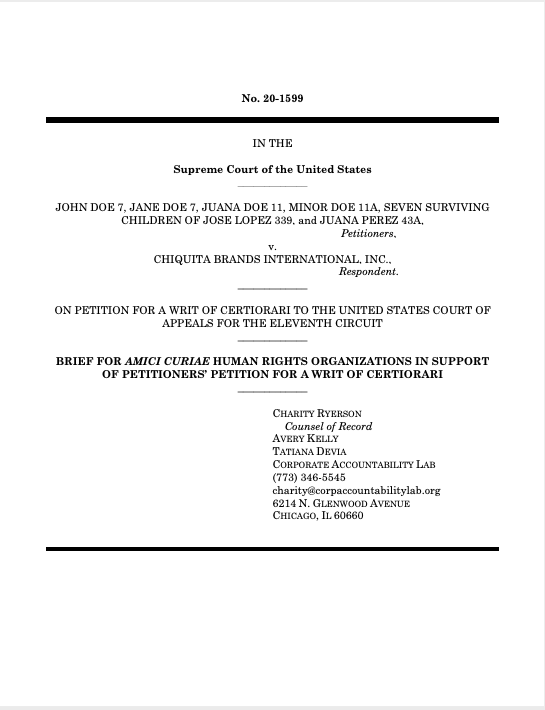
July 2021
Corporate Accountability Lab filed an amicus brief asking the US Supreme Court to grant certiorari in Doe v. Chiquita Brands International. The case was brought by the family members of trade unionists, banana workers, political organizers, social activists, and others targeted and killed by the United Self-Defense Group of Colombia (Autodefensas Unidas de Colombia, AUC), a right-wing paramilitary organization in Colombia funded in part by Chiquita, the US-based multinational banana company. The brief argues that the protective order that allows them to proceed without their names, addresses, phone numbers, or employment information being revealed to the public should not be lifted, as revealing the petitioners’ identities would put their lives at risk. In October 2021 the Supreme Court denied the petition for cert in the Chiquita case.

October 2020
Corporate Accountability Lab filed two amicus briefs in support of Respondents in the Nestle v. Doe case before the US Supreme Court, both about corporate liability under the Alien Tort Statute (ATS). CAL filed the two briefs on behalf of nineteen cocoa and chocolate companies that have structured their companies so that they source only slave-free cocoa. (One brief was filed on behalf of eighteen cocoa and chocolate companies and the other on behalf of a Dutch chocolate company, Tony’s Chocolonely.) All nineteen companies argued that it is unethical for companies to profit from cocoa produced with forced child labor, and that corporate liability for human rights abuses is essential for a fair and equitable economy.

August 2020
Corporate Accountability Lab joined the AFL-CIO, Freedom United, Global Labor Justice – International Labor Rights Forum, Human Trafficking Legal Center, Interfaith Center on Corporate Responsibility, Investor Alliance for Human Rights, Uyghur American Association, Uyghur Human Rights Project, and World Uyghur Congress to file a petition under Section 307 of the Tariff Act of 1930 with Customs and Border Protection (CBP), asking CBP to issue Withhold and Release Orders (WROs) against companies importing cotton and cotton-made goods from the Xinjiang Uygur Autonomous Region (XUAR), China, “manufactured in any part with” forced and/or prison labor.
February 2020
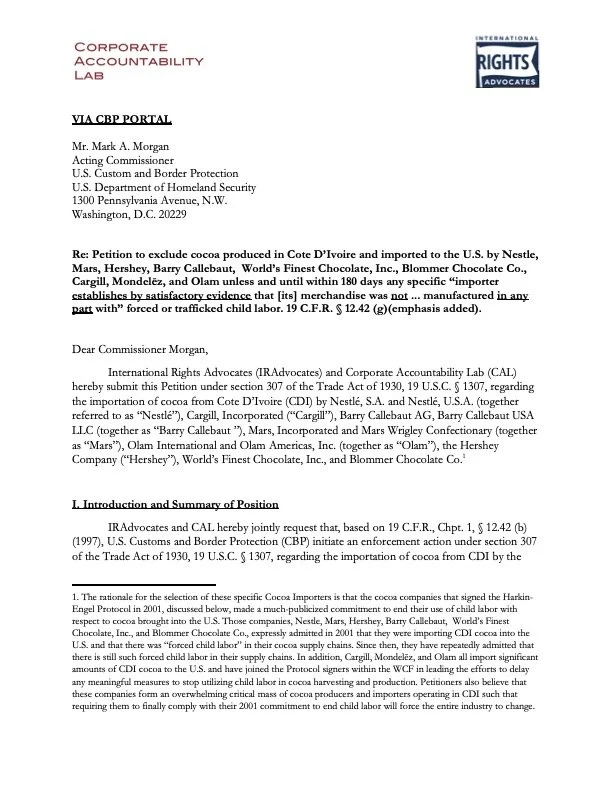
Corporate Accountability, International Rights Advocates, and the UC Irvine Civil Rights Litigation Clinic submitted a petition under Section 307 of the Tariff Act of 1930 to U.S. Customs and Border Patrol (CBP). The petition includes evidence of forced child labor in the Ivorian cocoa industry and requests that CBP issue a conditional Withhold and Release Order (WRO) against major cocoa importers, giving these companies 180 days to demonstrate significant changes to address their role in benefitting from forced child labor in the cocoa sector of Cote D’Ivoire. This was one of the first petitions submitted to CBP under Section 307. (For guidance on submission requirements for petitions to CBP under Section 307, see CBP’s submission guidelines and submissions checklist.)