LITIGATION
While not the only legal tool in our toolbelt, CAL participates in litigation against major corporate human rights abusers as a plaintiff, counsel, and amicus. Not all litigation can be publicly disclosed, but some active cases, closed cases, and amicus briefs are listed below.
CLOSED CASES
ACTIVE CASES
-
In 2023, CAL sued Sambazon, a multinational producer of açaí, for misleading consumers about their sourcing practices in an industry rife with hazardous child labor. CAL is continuing to litigate this case after a major win in the D.C. Court of Appeals.
-
In March 2026, Toxin Free USA (TFUSA) and Corporate Accountability Lab (CAL) filed a consumer protection lawsuit against Aqua Star Corp., for false and deceptive marketing of its shrimp products. While Aqua Star claims that its shrimp products are “pure,” “sustainable,” and “responsible,” in reality they may be tainted by antibiotics and, possibly, radioactive isotopes; they are produced under exploitative labor conditions, involving a high risk of forced labor; and they cause environmental harm. Aqua Star is a major seller of shrimp in the United States and sells its shrimp throughout the United States and Washington, D.C., including Target, Giant, Balducci’s, Safeway, Save A Lot, Harris Teeter, and Kroger.
-
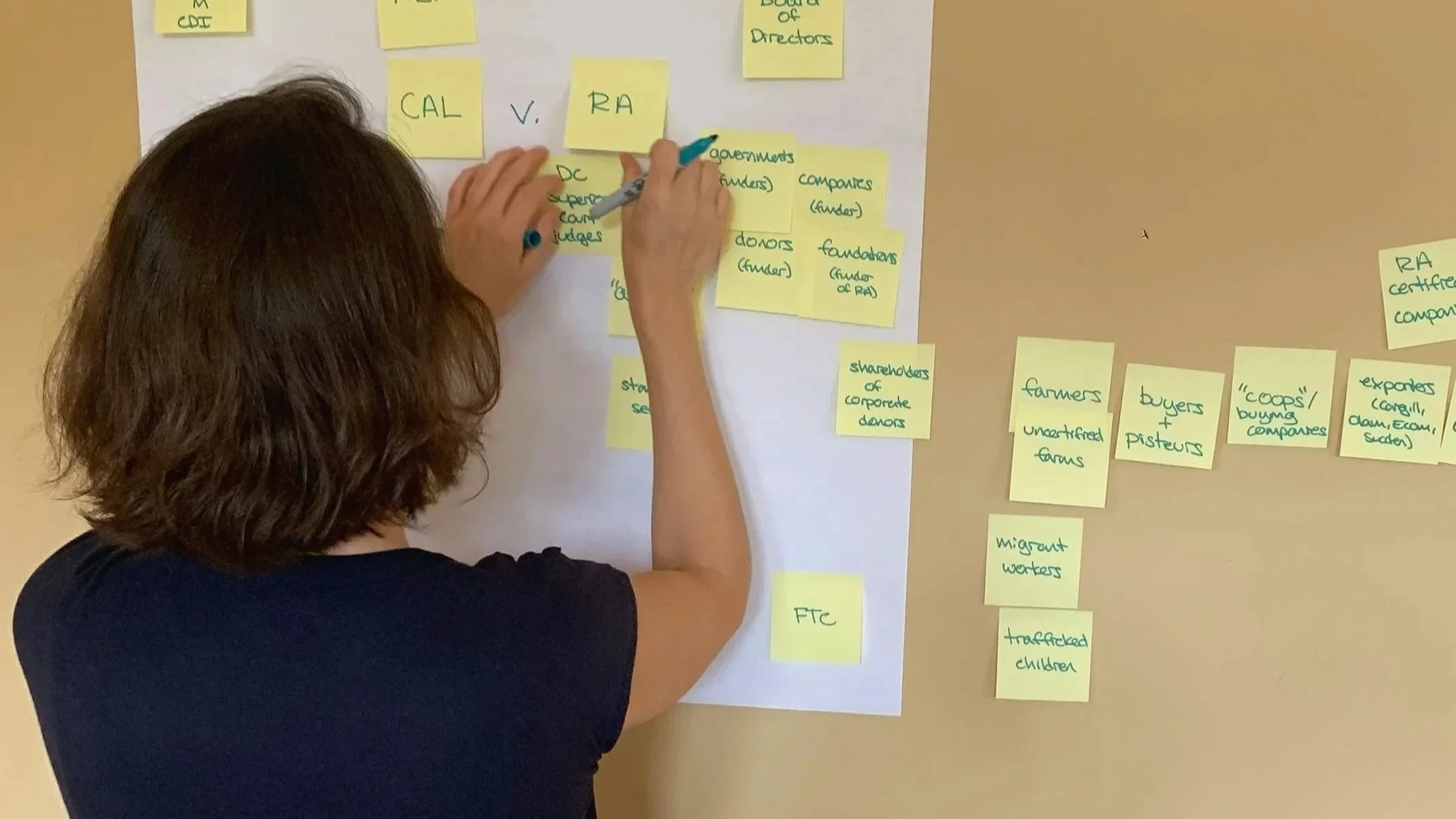
In 2021, CAL sued Hershey for using the Rainforest Alliance certification on their products to deceive consumers into believing their products were sustainable and responsible, despite the presence of child labor in their supply chains. This case ended in a landmark settlement in 2024 wherein Hershey agreed not to use the Rainforest Alliance seal on its products.
AMICUS BRIEFS
-
In March 2026, CAL signed on to an amicus brief filed by the Uyghur Human Rights Project in support of Respondents, a group of Falun Gong practitioners who were persecuted and tortured in China by the Chinese Communist Party. Cisco Systems, from its headquarters in the U.S., is alleged to have provided and managed the surveillance system that initially identified and disclosed those who were tortured.
-
In 2021, CAL filed an amicus brief asking the U.S. Supreme Court to grant certiorari in the case, Doe v. Chiquita Brands International. The case was brought by the family members of trade unionists, banana workers, political organizers, social activists, and others targeted and killed by the United Self-Defense Group of Colombia (Autodefensas Unidas de Colombia, AUC), a right-wing paramilitary organization in Colombia funded in part by Chiquita, the US-based multinational banana company. The plaintiffs sued Chiquita, alleging that Chiquita aided and abetted the AUC by financing them.
On June 10, 2024, after seventeen years, a federal jury in West Palm Beach, Florida returned a unanimous verdict for the plaintiffs in In re. Chiquita Brands International Inc. This verdict is a truly herculean triumph – for the first time, a U.S. jury held a domestic corporation accountable for human rights abuses associated with its supply chain and conduct abroad.
-
CAL filed two amicus briefs in support of Respondents in Nestlé USA v. Doe before the U.S. Supreme Court on behalf of nineteen cocoa and chocolate companies that structured their companies to source only slave-free cocoa. To address the risk of unfair competition by companies that have failed to eliminate child trafficking in their supply chains, the ethical chocolate and cocoa companies argued in favor of civil liability for such conduct under the Alien Tort Statute. Unfortunately, the Supreme Court found that the plaintiffs (former forced child laborers) had not alleged enough domestic conduct by the defendants (Nestlé USA and Cargill) to sufficiently link the case to the United States.
-
In August 2023, attorneys at Corporate Accountability Lab (CAL), Global Labor Justice-International Labor Rights Forum (GLJ-ILRF), and the Law Offices of John Burton filed an amicus curiae brief with the Ninth Circuit Court of Appeals on behalf of more than twenty human rights organizations and U.S. shrimp producers supporting the plaintiffs in Ratha v. Rubicon Resources, LLC. The Ratha plaintiffs’ lawsuit targets Rubicon Resources, LLC (Rubicon), alleging the company attempted to sell shrimp produced with this forced labor. The Ninth Circuit ruled that the plaintiffs failed to provide evidence that Rubicon knowingly benefitted from participation in a venture that it knew, or should have known, was violating the Trafficking Victims Protection Reauthorization Act (TVPRA). To put it simply, the court interpreted the TVPRA in such a way that defendants who tried to profit from forced labor, but were unsuccessful in doing so, were shielded from liability. However, in 2024, Congress passed the Abolish Trafficking Reauthorization Act, or ATRA, which clarified that the TVPRA imposes liability on a defendant who knowingly “attempts or conspires to benefit” from participation in a venture that it knew or should have known was engaged in acts that violated the TVPRA. In March 2025, the Ninth Circuit issued an order requiring the Ratha case to be reheard en banc, reopening the door for plaintiffs to reargue their case and to be granted a second chance at receiving justice.