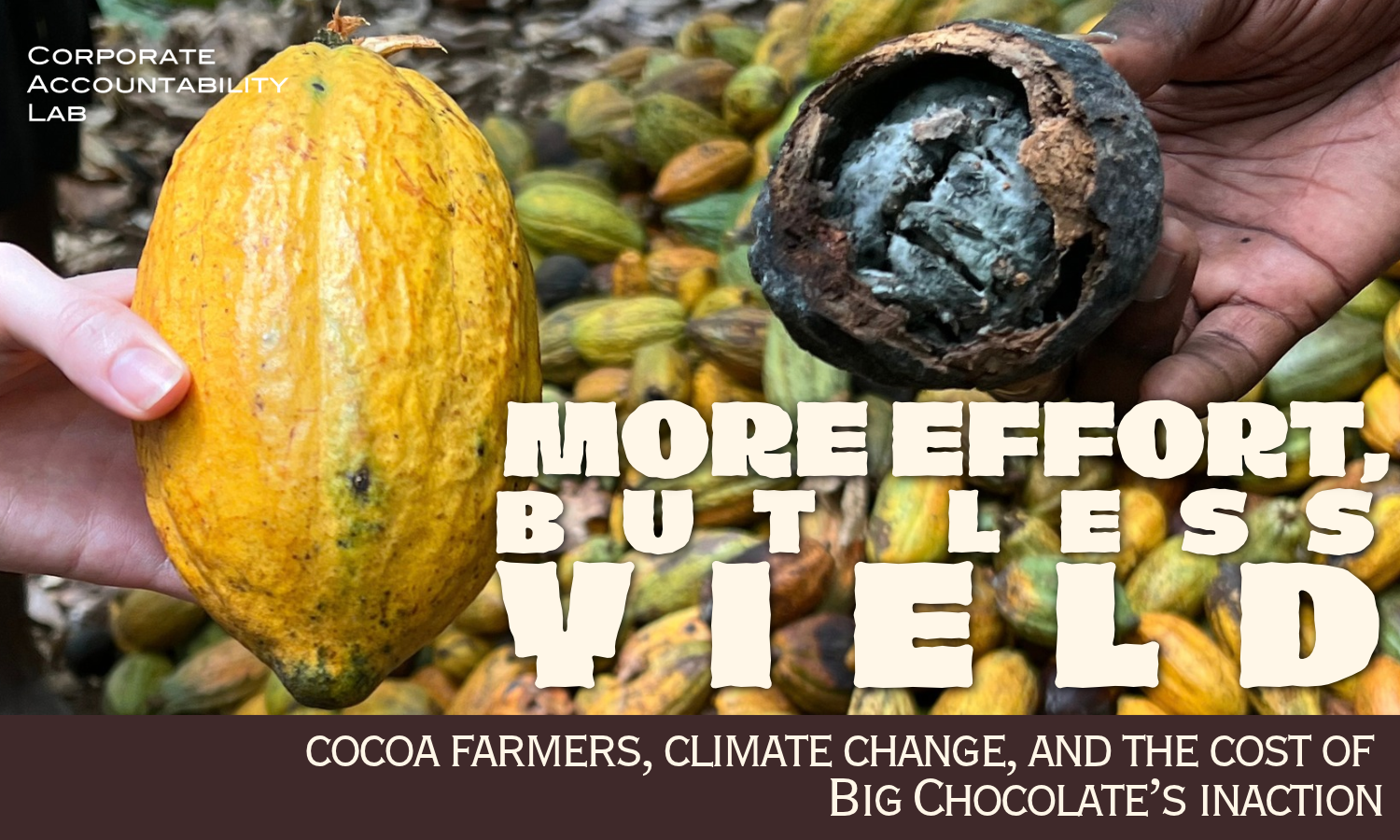
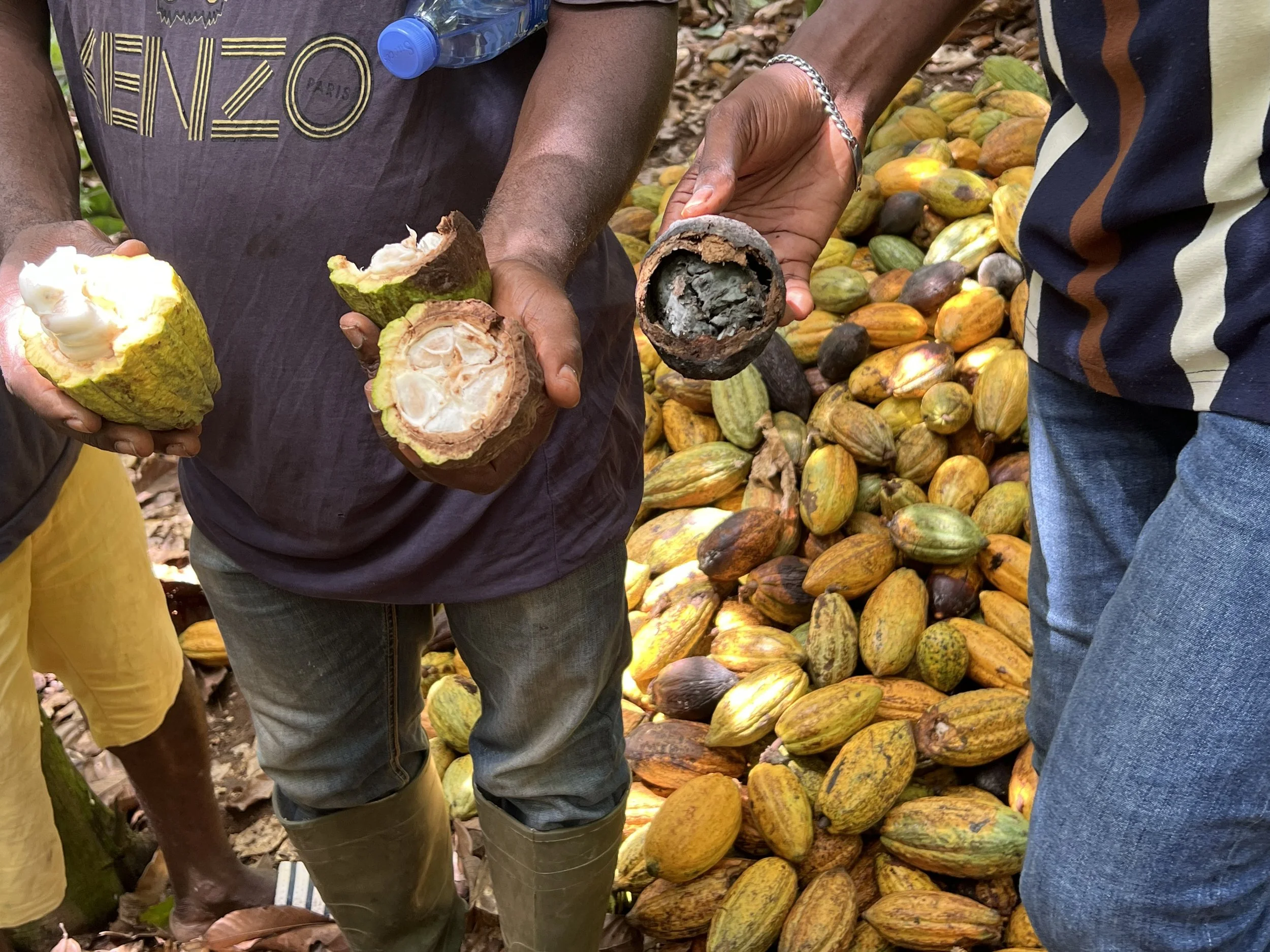
The climate crisis not only risks eliminating the world’s favorite treat, but also the livelihoods of hundreds of thousands of cocoa farmers! Cocoa-purchasing companies depend on the hard labor of cocoa farmers, who remain trapped in poverty and burdened by low incomes despite their integral role in the global cocoa supply chain. More frequent extreme weather events and shifting rainfall patterns are reducing cocoa yields, which makes it increasingly difficult for farmers to produce enough cocoa to support themselves and their families. As a result, vulnerable farming communities face greater economic insecurity as cocoa production declines.
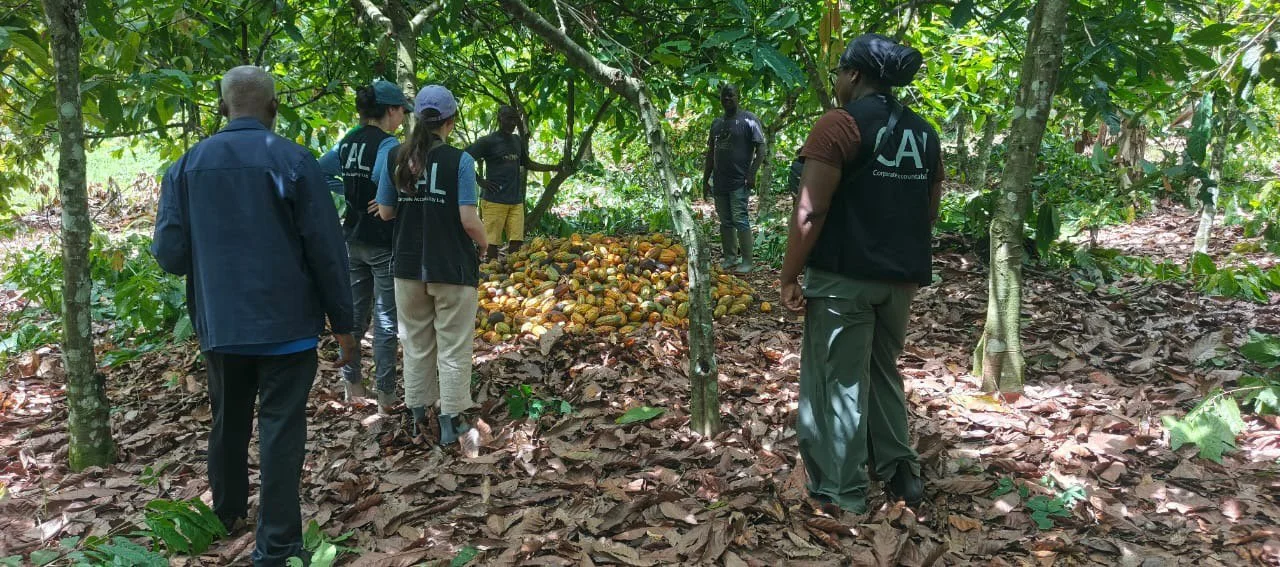
In May 2026, CAL staff conducted a two-week investigatory trip to Côte d’Ivoire, the world’s largest cocoa producer, to learn from farmers about how climate harm is impacting their well-being, livelihoods, and farming practices. This report builds upon CAL’s previous work in the West African cocoa sector, including our three prior reports, There Will Be No More Cocoa Here: How Companies Are Extracting the West African Cocoa Sector to Death (2023); Always Left Holding the Bag: The Economic Impacts of the COVID-19 Pandemic on Cocoa Farmers and Children in Côte d’Ivoire (2021); and Empty Promises: The Failure of Voluntary Corporate Social Responsibility Initiatives to Improve Farmer Incomes in the Ivorian Cocoa Sector (2019).
CAL previously warned about the impact that the impending climate crisis would have on cocoa farmers, but the dominant cocoa-purchasing companies have yet to take meaningful action to safeguard these vulnerable and essential participants. Now, three years after CAL’s original reporting on the climate crisis, the situation is even more dire. This report details our findings, examines how climate change contributes to preexisting social and economic issues that Ivorian cocoa farmers face, and demonstrates why they cannot and should not bear the burden of effective adaptation.
Chocolate Company + Sustainability Certification Responses
CAL reached out to a number of chocolate companies as well as sustainability and fairtrade certification companies about our findings. Their responses are below. Nestlé, Mondelez, Ferrero, and ECOM did not respond to our request for comment.
-
Barry Callebaut sources cocoa through both direct sourcing operations and third-party suppliers. We know the companies from which we purchase cocoa and apply supplier requirements and risk-based due diligence across our supply chain. For commercially sensitive reasons, we do not publicly disclose the detailed split between our direct and indirect cocoa volumes.
Barry Callebaut does not see innovation in cocoa and chocolate solutions as a replacement for our long-term commitment to cocoa farmers. Cocoa remains at the heart of our business, sourcing strategy and Forever Chocolate commitments. Innovation allows us to respond to different customer applications, consumer preferences and market conditions, while we continue to source cocoa and invest in the resilience and prosperity of cocoa-growing communities.
Barry Callebaut recognises that certification alone is not sufficient to identify and address complex supply chain sustainability risks such as forced labor, child labor, and deforestation. While certification remains an important tool within our sustainability strategy, it does not replace robust due diligence processes.
With regards to human rights, we follow the OECD’s six-step framework as a structured process to identify, prevent and address human rights risks across our value chain. Our HRDD approach combines policies and management systems, supplier requirements, risk and impact assessments, and capacity-building of our staff, including trainings on detecting signs of potential forced labor. Our grievance mechanism remains essential to embedding responsible business conduct and ensuring accountability by enabling employees, farmers, suppliers and other stakeholders to report concerns through multiple channels. Additionally, our Global Human Rights Response Protocol provides guidance to the Compliance team, employees and partners on how to respond, escalate and manage potential human rights cases, including forced labor.
Similarly for deforestation, Barry Callebaut does not rely solely on certification claims. Our Forest Positive approach is built on a comprehensive three-tiered due diligence framework aligned with EUDR requirements:
Country level: We assess structural risks associated with cocoa production, including cocoa-linked deforestation, traceability gaps, and legality risks. The results inform sourcing decisions and priorities for forest protection interventions.
Supplier level: We evaluate suppliers' ability to deliver traceable and deforestation-free volumes in line with EUDR requirements. The assessment reviews suppliers' due diligence processes across four thematic areas: governance, traceability, legality, and deforestation.
Farm level: We collect farm-level data, including farmer identity, farm size, GPS coordinates and farm polygons. These georeferenced farm boundaries are overlaid with land-use and tree cover loss data to assess deforestation risk. To support this process, we work with Starling, leveraging high-resolution satellite imagery and geospatial analysis to monitor forest disturbance within and around cocoa farms.
Where risks are identified, Barry Callebaut applies an appropriate risk mitigation measures. More information, including risk mitigation approaches can be found in our Forest and Natural Ecosystems Policy.
Barry Callebaut publicly reports on its responsible sourcing, traceability, deforestation monitoring, human rights due diligence through its Annual ESG Report and other sustainability disclosures.
Barry Callebaut's sustainability reporting is subject to independent third-party assurance. Selected key performance indicators (KPIs) are annually reviewed by an independent assurance provider, with the scope and methodology publicly disclosed in the company's Assurance Report. Furthermore, for deforestation, we use independent geospatial and satellite-monitoring tools, including Starling. These multiple layers of verification provide additional confidence in the reliability of the information reported and the effectiveness of our due diligence processes.
Barry Callebaut invests significantly in climate and environmental sustainability initiatives as part of our Forever Chocolate and Thriving Nature strategies, including large scale forest protection, agroforestry, traceability, farmer livelihoods, and climate action. While we publicly report on our sustainability commitments, activities and outcomes, we do not publicly disclose detailed annual budgets or country-specific investment allocations. However, stakeholders can gain an understanding of the scale and scope of these investments through Barry Callebaut's annual ESG Report, which outlines key programmes across sourcing origins.
-
Hershey continues our commitment to cocoa resiliency and farmer wellbeing through our Cocoa For Good strategy, backed by a more than $500 million investment. We encourage you to review our latest Responsible Business Report, published in June 2026, and our corporate website for additional information about our commitments, ingredient quality standards, and sustainability progress. We update our disclosures annually, and the latest data on traceability and regenerative agricultural commitments can be found on pages 12-27 of the report. A list of farmer organizations partnering with Cocoa For Good is available on the interactive map on our website.
In addition to individual company efforts, collaborative action like TogetherCocoa is needed to help close the living income gap for cocoa farming households in Côte d’Ivoire and Ghana. TogetherCocoa will build on Hershey’s ongoing efforts to invest in the people who grow our ingredients. We remain committed to our existing programs. For more information on TogetherCocoa, please reach out to the Foundation.
Hershey is focused on delivering the products and quality consumers expect from our brands. Please see our website for more information on steps we are taking to extend the classic milk and dark chocolate recipes in our portfolio. Hershey has no active research and development or product commercialization work on cocoa substitutes or alternatives underway or planned.
-
Our cocoa suppliers in Ghana have agreed to adhere to our robust Supplier Code of Conduct and we have also been clear that they must have a Child Labor and Remediation System (CLMRS) in place by 2025 that complies with the industry leading International Cocoa Initiative (ICI) standard. Over 65% of our cocoa supply in West Africa is already covered by CLMRS which is implemented by our suppliers on the ground, with audits conducted by certification bodies as part of Rainforest Alliance and Fairtrade certification requirements.
We have a robust Protecting Children Action Plan in place that is backed by a significant financial investment totaling hundreds of millions of dollars over the coming years. We are also transparent in saying that we know that more needs to be done and we continue to work diligently with parties across the cocoa sector to further help advance respect for human rights in the cocoa supply chain.
Cocoa is an integral ingredient in our beloved chocolate products, and we know a sustainable cocoa sector is essential to ensure we can continue to provide chocolate for future generations of chocolate lovers. To help advance that goal, Mars has partnered with governments, non-governmental organizations, and other stakeholders to help promote human rights and address the root causes of deep-rooted systemic issues such as child labor.
For more information in-line with cocoa sustainability or any questions, feel free to visit our website: Cocoa for Generation.
-
We are in receipt of your email dated 17 August 2026, with an attached query regarding our certification program in Cote d’Ivoire, West Africa.
Please note that as a 501(c) (3) nonprofit organization operating with limited staff and resources, the Rainforest Alliance does not have the capacity to respond in depth to inquiries that are not made in good faith or in service of fair, balanced reporting. We consider this inquiry to fall into that category based on our prior experience with your organization. Nonetheless, we will respond on a limited basis in the interest of maintaining the integrity of our program.
The Rainforest Alliance certification is a system of requirements, independent assurance, monitoring, and remediation. The Rainforest Alliance farm certification program follows structured rules divided into Certification Rules for Farms (for growers) and Auditing Rules for Farms (for independent Certification Bodies). All farms must comply with the Sustainable Agriculture Standard, undergo independent on-site third-party evaluations, and resolve any non-conformities within specific timeframes in order to trade Rainforest Alliance Certified crops. For more information on our certification program, and the Certification and Auditing Rules, please go here.
Regarding your question on mass balance – we encourage cocoa companies to use a segregated sourcing model, in which certified ingredients are kept separate from non certified ingredients. At the same time, mass balance enables significantly more smallholder farmers to participate in certified supply chains, whereas physical segregation would otherwise create substantial cost and logistical barriers. For more information on mass balance, please go here.
Regarding your question on signage - for certified cocoa cooperatives in Côte d’Ivoire, signage by itself is not the basis for certification, nor is the mere presence of a sign treated as evidence that child labor risks are adequately managed. However, certified organizations are required to ensure that information on these prohibited practices is visibly displayed in a central location at all times. This requirement is one part of a broader assessment of whether the cooperative has functioning systems to prevent, monitor, identify, and address child labor risks. If this information is not visibly displayed, the auditor would raise a nonconformity that the organization must correct. The certification decision is based on the organization's overall conformity with the standard, including the effectiveness of its Assess and Address system, rather than on signage alone.
The Rainforest Alliance has long recognized the ongoing challenges in cocoa farming in West Africa, including the serious issues around child labor, deforestation, and the economic well-being of cocoa farmers. These challenges are a top priority for our organization and have been for quite some time. That said, regular certification audits cannot be expected to “find everything, everywhere, all the time”. No single organization or system can provide a 100% guarantee that such violations do not occur within a supply chain. To expect that oversimplifies a deeply complex problem that includes contributing factors such as deep poverty, migration, and inequality.
When credible, concrete allegations arise from any stakeholder, Rainforest Alliance initiates an investigation, which can include unannounced audits and off-site interviews with workers. If non-compliances are not resolved, additional measures can be taken, including decertification.
The Rainforest Alliance believes we have a shared responsibility, along with all actors in the global supply chain, to help bring the cocoa sector in West Africa to a more sustainable reality, and we remain committed to our mission-driven work.
-
Fairtrade recognises the serious concern that abuses, such as forced labour and deforestation, can go undetected in supply chains. However, no certification system, including Fairtrade, can guarantee that every violation will be identified.
FLOCERT, Fairtrade’s independent auditor, uses an assurance approach that includes risk based audits and unannounced audits, as well as mechanisms that allow all stakeholders and the public to report allegations directly and confidentially.
In regions considered high-risk due to known issues, such as cocoa in Cote d’Ivoire, producer organisations are likely to be audited annually and receive a higher number of unannounced audits for additional risk management.
Looking for signs of child labour or forced labour is part of every audit, especially when inspecting the farms and fields. FLOCERT auditors are given intensive training on how to spot such labour and ask the right questions. The auditors are also trained specifically to distinguish illegal child labour from typical (non-detrimental, non-hazardous) child work.
Regarding deforestation, Fairtrade’s Standard for Small-scale Producer Organisations (SPO) does not allow certified cooperatives to have members in protected areas. Cocoa farms have to be geo-mapped. If the farms are bigger than four (4) hectares, they have to be polygon-mapped. During audits, sampling of sites near risk areas is part of the audit protocol and includes a more focused investigation.
Furthermore, when producer organisations submit their geolocation data to Fairtrade, a deforestation risk analysis is conducted and shared back to the producer organisation.
Fairtrade Standard for Cocoa requires that there has been no deforestation on farms since 31 December 2018 (Section 3.4.1), and that based on the producer organisations’ human rights/environmental risk assessment, a plan be created to prevent and mitigate any deforestation (Section 3.4.3.)
On mass balance:
Like other certification schemes, Fairtrade also uses a mass balance approach to ensure farmers and workers have the most opportunities to sell their certified crops. Under mass balance, companies may mix Fairtrade and non-Fairtrade amounts of an ingredient during the manufacturing process as long as the actual volumes of sales on Fairtrade terms are tracked and audited through the supply chain.
The ability to use mass balance reflects that in the chocolate industry, cocoa is routinely mixed at the point of shipping or manufacture, and there are complex processes of manufacturing. Fairtrade will certify either mass balance or physically segregated cocoa.
This process ensures that Fairtrade farmers are not excluded from sales opportunities while consumers can be sure that the amount of ingredients in the final Fairtrade labelled product matches the amount sold by the farmers. Given the depth of poverty experienced by many producer organisations and their members, and the urgency of their need for better terms of trade, this is a workable solution that has given thousands of farmers the opportunity to benefit from Fairtrade.
In 2024, Fairtrade cocoa farmers in Cote d'Ivoire earned more than €60 million in Fairtrade Premium. The Fairtrade Premium is an extra sum of money paid on top of the selling price that farmers invest in social, economic, or environmental projects of their choice.
Finally, Fairtrade believes in traceable supply chains, linking farmers to consumers, and their critical importance to responsible sourcing. We encourage the global chocolate industry to continue investing in traceability and to work together to make it happen. At the same time, farmers' livelihoods must remain at the centre of these efforts.
Fairtrade does not require cocoa cooperatives in Côte d’Ivoire to place signs specifically forbidding child labour as a condition of certification. Fairtrade’s Standard for Small-scale Producer Organisations (SPO) (Section 3.3.*) prohibits child labour in all forms and encourages farms to develop a rights-based remediation policy and program that covers how to withdraw the children and how to prevent them from entering into worse forms of labour.
For cocoa specifically, the requirements go further. The Fairtrade Standard for Cocoa requires that an agreement is in place with each individual member specifying the rights and obligations of both parties in relation to Fairtrade certification, including a commitment by both the member and the SPO to comply with the Fairtrade Standards and to participate in both external and internal audits.
What matters for Fairtrade certification is that the mandatory requirements of our standards are met and whether any non-conformities identified through the certification process are addressed in accordance with Fairtrade’s certification rules.
Signage is one way that certified organisations and their members can communicate the prohibition of child labour and demonstrate awareness, but it is not a substitute for the requirements of Fairtrade standards.
-
Details of ofi’s direct cocoa supplier network can be found on our website here.
Our published information about ofi’s work in our cocoa origins including, Côte d’Ivoire, can be found in our Cocoa Compass Impact Report. This is our 2024 report published in 2025. Our 2025 report will be published later this year.