Today, U.S. shrimpers filed a complaint with the U.S. International Trade Commission (ITC) to block imports of shrimp from India that are produced with forced labor. The complaint, filed under Section 337 of the Tariff Act of 1930 (codified at 19 U.S.C. § 1337), argues that forced labor constitutes an unfair act or method of competition under the statute.
Corporate Accountability Lab (CAL), along with Picard, Kentz & Rowe, LLP, represents two U.S. shrimpers: Versaggi Shrimp Corp. and W & W Dock, LLP. These shrimpers catch high-quality shrimp in full compliance with U.S. labor laws, ensuring respect for fundamental labor rights.
These domestic shrimpers are threatened, however, by major Indian shrimp companies that rely on forced labor to keep their prices low. To that end, the shrimpers have named Nekkanti Sea Foods Ltd., an Indian shrimp producer alleged to rely on forced labor in their shrimp processing facilities, as proposed respondents in the case. The shrimpers also included Nekkanti’s upstream importers and sellers as proposed respondents: wholesaler Eastern Fish, and U.S. grocery store chains ALDI, Meijer, and Ahold Delhaize (owner of Food Lion, Giant, Hannaford, and Stop & Shop).
The U.S. shrimpers are asking the ITC to issue an exclusion order that would stop all shrimp produced by Nekkanti with forced labor from entering the United States. This blog summarizes their claims.
The Facts: Alleged Forced Labor in India
In 2024, CAL released a report – Hidden Harvest – detailing conditions in the Indian shrimp industry, including at two of proposed respondent Nekkanti’s facilities in Andhra Pradesh. That reporting, along with investigations from the Outlaw Ocean Project, the Associated Press, and CNN, documented the abhorrent conditions of the largely female workforce in the Indian shrimp sector. As the complainants in this case have alleged, those conditions in many instances include forced labor.
Nekkanti is a large shrimp exporter, producing over 32,000 metric tons of shrimp each year, most of which is sold to the United States. Nekkanti produces shrimp via aquaculture, meaning that they sell shrimp raised from “seeds” (small shrimp eggs) in hatcheries and, later, in large saltwater ponds. Their facilities are concentrated in Andhra Pradesh, a state on the southeast coast of India. (Nekkanti owns some shrimp farms, but they are best known for processing fully-grown shrimp.)
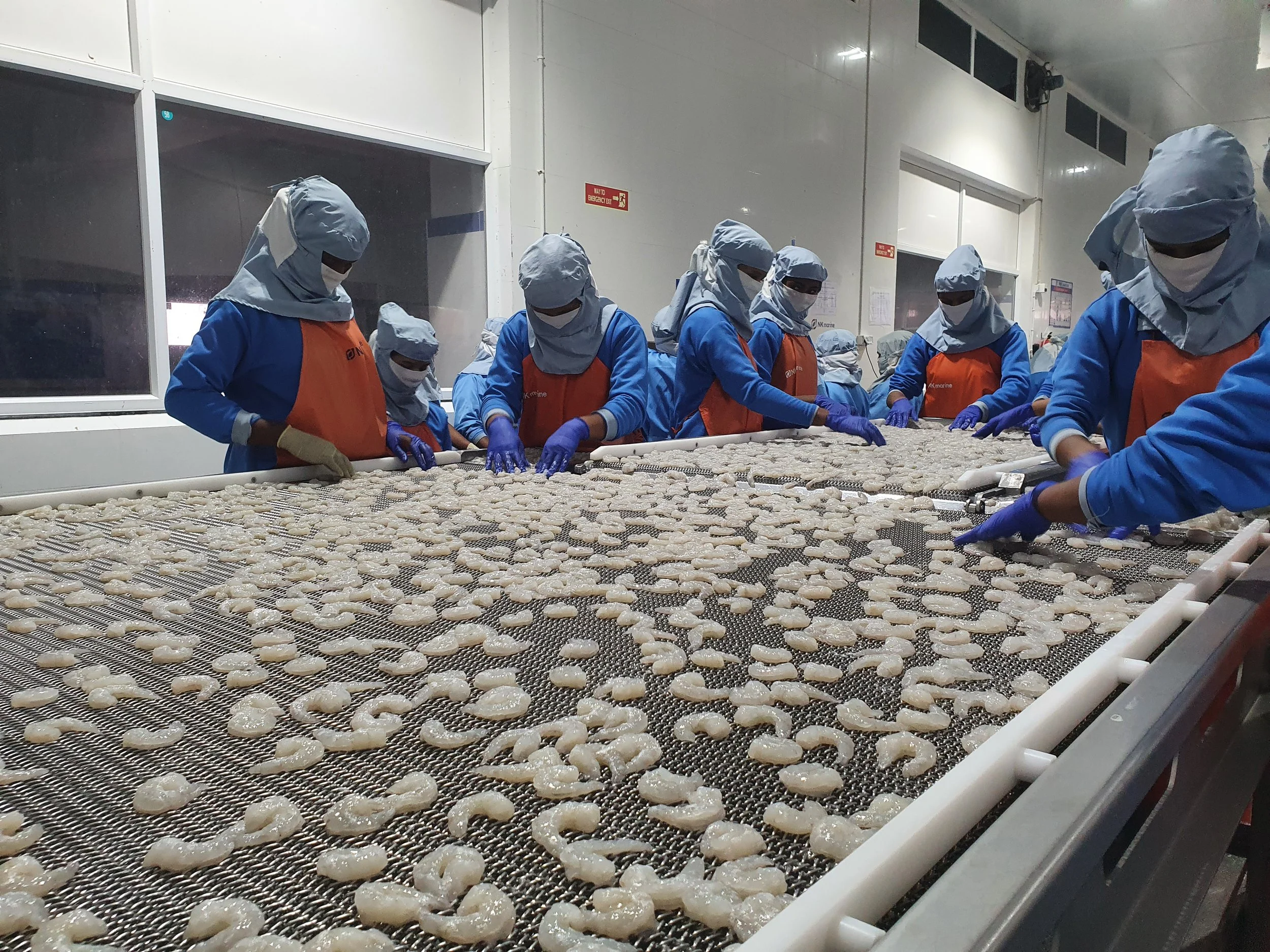
Most of the workers at Nekkanti are women, and many of them are migrants from other Indian states, especially Odisha, where climate change or worsening economic prospects have forced families to give up farming. Many of these migrant workers are especially vulnerable as they are members of the Dalit caste or of the Adivasi tribal group. According to the complaint, these workers live in guarded company hostels. Proposed respondent Nekkanti allegedly restricts the workers’ movements, in certain cases only allowing them to leave their lodgings once a month, and even then the complaint maintains that the workers are under strict curfews and often monitored.
Not only do most of these workers earn less than the minimum wage in Andhra Pradesh, in certain cases they report not being paid for overtime work. Many of the workers at Nekkanti are paid through third-party contractors, not by the companies themselves, and these contractors take a cut of the workers’ already paltry wages. In some cases, as the complaint alleges, workers must pay a month’s wages to the contractor every year. Workers have also reported that they do not have official contracts for their employment. Recruitment fees, underpayment, and exploitation leave workers trapped in their jobs without any hope of improving their position. These risks are enhanced for migrant workers, who often have preexisting debt, do not speak the local language, and have limited social connections.
Complainants’ allegations against Nekkanti are similar to reports of conditions in the Indian shrimp industry more broadly, where the working conditions at processing plants are abusive and dangerous. The U.S. Department of State described “indicators of forced labor . . . in some shrimp and aquaculture facilities, particularly in Andhra Pradesh.” According to other reporting, women workers handle frozen shrimp for hours on end; some have reported frostbitten fingers, while others have contracted nail fungus. Some workers suffer fainting spells from standing for long hours in the cold processing plants without adequate food. On top of the harsh physical conditions, managers verbally abuse workers, especially women, for simply talking amongst themselves or taking too long to use the restroom.
The alleged conditions that workers at Nekkanti’s processing facilities endure to produce shrimp for U.S. grocery stores constitute forced labor. The International Labour Organization (ILO) defines forced labor as “all work or service which is exacted from any person under the menace of any penalty and for which the said person has not offered himself voluntarily.” Several of the ILO’s indicators of forced labor are present at these facilities: abuse of vulnerability, restriction of movement, withholding of wages, excessive working hours, debt bondage, and abusive working and living conditions.
Impacts on the U.S. Market
The scourge of forced labor not only impacts the workers; it also affects the U.S. shrimp market. Nekkanti and wholesaler Eastern Fish sell shrimp to U.S. grocery stores, including to proposed respondents ALDI, Meijer, and Ahold Delhaize. These stores sell shrimp from Nekkanti alongside domestic shrimp from the U.S. Gulf Coast. Consequently, U.S. shrimpers such as the complainants must compete with shrimp produced with forced labor, which can sell at a lower price.
Complainants argue that Nekkanti has an enormous and unfair advantage over the complainants because they use forced labor at their facilities. Forced labor is cheap – companies use it to cut costs, and the U.S. Trade Representative estimates that global forced labor generates $150 billion in profits annually. As complainants allege, Nekkanti does not pay their workers fair wages or spend money on adequate living and working facilities. The oppressive conditions workers allegedly face at Nekkanti plants allow the companies to cut corners and costs, leading to a cheaper end product for the supermarkets.
Complainants cannot compete with Nekkantis’ unfairly low prices. These domestic shrimpers pay their workers fair wages and conduct their business in full compliance with U.S. law. Because complainants do not cut corners on labor costs as the Indian shrimp companies do, they cannot afford to charge the same low price for their products. As Justin Versaggi of complainant Versaggi Shrimp put it: “It’s been absolutely crippling, and it’s just not fair . . . We can’t compete with foreign . . . sweatshop-type labor.”
The Argument: Forced Labor at the ITC
These facts, as complainants allege, are sufficient to support a Section 337 complaint. Complainants argue that importing goods produced with forced labor violates federal law and distorts competitive conditions, harming a U.S. industry and therefore requiring the ITC, under Section 337, to issue an exclusion order. The goal is to enable victims of forced labor and affected U.S. industries to obtain a powerful trade remedy.
The ITC, which considers complaints under Section 337, typically deals with intellectual property disputes. Section 337, by its terms, prohibits “[u]nfair methods of competition and unfair acts in the importation of goods” that have a harmful effect on a U.S. domestic industry. Complainants argue that proposed respondent’s alleged use of forced labor is just such an “unfair act or method of competition” that the ITC can and should address. This understanding does not stretch the statute or expand it beyond its scope. Section 337 itself does not define what constitutes an unfair method of competition or unfair act. Nor does the text of the statute limit the ITC’s jurisdiction solely to patent or intellectual property disputes.
The legislative history of Section 337 shows that the drafters intended for unfair methods and acts to be broadly construed, covering every type of unfair practice. The 1922 Senate Report on the Tariff Act states that “[t]he provision relating to unfair methods of competition in the importation of goods is broad enough to prevent every type and form of unfair practice.” Further, as the former Court of Customs and Patent Appeals explained in a foundational case, In re Von Clemm, in Section 337 procedures, Congress “intended to allow wide discretion in determining what practices are to be regarded as unfair.” As such, complainants argue, Congress invested the ITC with authority to deal with a wide range of practices that distort competition, including forced labor.
Forced Labor as an Unfair Method of Competition
So, how do you determine whether something qualifies as an unfair method of competition or unfair act? The Federal Circuit has already explained that the answer to this question should be “decided under a uniform federal standard.” TianRui Grp. Co. v. Int’l Trade Comm’n, 661 F.3d 1322, 1327 (Fed. Cir. 2011). And complainants here offer such a federal standard: violation of a federal law. The ITC has recognized that violating some predicate federal statutes can give rise to a Section 337 claim, such as violations of the Sherman Act and the Prevent All Cigarette Trafficking Act.
As described above, forced labor is a multibillion dollar industry, allowing companies to cut costs by mistreating workers. The serious economic impacts of forced labor is something that Customs and Border Protection (CBP), the Department of Labor, the U.S. Trade Representative, the Department of Justice, and the ILO have all recognized. But beyond just giving companies a competitive edge, importing goods produced with forced labor also violates federal law: Section 307 of the Tariff Act. Section 307 prohibits importing goods “manufactured wholly or in part in any foreign country by convict labor or/and forced labor or/and indentured labor.” Complainants argue, then, that when proposed respondents violate Section 307 by importing shrimp produced by forced labor, this violation is evidence of an unfair act under Section 337.
The typical method of seeking redress under Section 307 is to file a complaint with CBP seeking a Withhold Release Order (WRO), which is a type of import ban. But the WRO is a blunt tool, and complainants are not privy to CBP’s investigative or decision making process, sometimes waiting years to find out whether CBP will issue a WRO. Section 337 complaints in the ITC, in contrast, are a full adjudicative process that allows both sides to present evidence and for the ITC, if it so chooses, to institute a full investigation, to issue an exclusion order for importers, and to issue cease and desist orders for downstream sellers.
And, as complainants argue, although Section 307 complaints are submitted to CBP, nothing in either Sections 307 or 337 indicate that CBP has exclusive jurisdiction over forced labor claims. In fact, multiple other agencies – including the Department of Justice, the Department of Labor, and the U.S. Trade Representative – exercise their powers to address forced labor in imports.
In sum, complainants argue that proposed respondent Nekkanti’s alleged use of forced labor distorts competitive conditions, leading directly to economic harms in the U.S. shrimp industry. Because forced labor is an unfair method of competition and an unfair act that violates federal law, and because the use of forced labor injures complainants’ U.S. shrimp businesses, complainants request that the ITC act under its Section 337 authority to issue a trade remedy to protect U.S. shrimpers. This would, ultimately, have a beneficial impact on the workers who are victimized by the underlying labor abuses.
What Comes Next
The shrimpers filed their case on October 28, 2026. Once the Federal Register publishes its notice about the complaint, there will be an eight-day period for the public to submit comments in support of (or against) the ITC Commissioners instituting (that is, accepting) the case. There is then a thirty-day period during which the Commissioners decide whether or not to institute it – that is, whether or not to open an investigation and instruct an administrative law judge regarding how to proceed.
The ultimate remedy in this case would be a total ban on the importation of goods from proposed respondents that were produced with forced labor. An import ban is an extremely powerful pressure point that would leave the respondents little choice but to stop their labor abuses if they ever wish to sell shrimp in the United States again. A positive outcome in this case should lead to tangible improvements in the living and working conditions for the many workers suffering under forced labor at these Indian shrimp facilities.
To read more, click here.
To read the press release, click here..
Tony Maquiling is a Legal Fellow at CAL.
